

If you have ever read Plato's Cave, you already know the image. Prisoners chained in a cave mistake shadows on the wall for reality, because shadows are all they have ever been allowed to see. If you are not familiar with the allegory, the SparkNotes overview gives you the gist in a couple of minutes. What is remarkable is that an idea written nearly 2,400 years ago, long before invoices, ledgers, or accounts receivable existed, still describes how we misread problems today with unsettling precision. Plato was writing about knowledge and perception, but the pattern he identified maps almost perfectly onto how modern businesses handle collections. Many companies make the same mistake the prisoners do. They see an unpaid invoice and assume the problem is the customer, when the invoice may only be the shadow of a deeper system issue, an unclear term agreed months earlier or a document that never reached the right desk. The companies that recover the most are the ones that stop chasing shadows and start mapping the systems that create them.
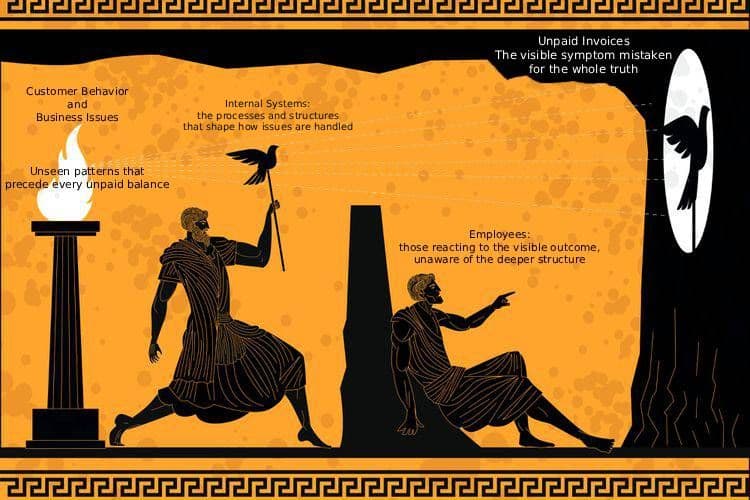
The shadow on the wall
Most companies measure collections by what is easiest to see, and there is comfort in that. An aging report shows how much is outstanding and how long it has been owed, and those numbers are real, but they are projections of something happening upstream. A 90-day unpaid invoice tells you an account is late. It stays silent on why. The customer may be waiting on a purchase order. They may dispute the amount. They may have approved the payment internally weeks ago while the invoice sits in someone's inbox with a wrong billing address. Each of those situations calls for a different response, and the aging report treats them all the same.
That report is the cave wall, and like the prisoners, we grow attached to it precisely because it is steady and legible. It is useful, and it becomes a trap when it is the only view. A collector staring at aging buckets may keep calling the same AP inbox when the real issue is a missing delivery confirmation or a salesperson who promised different terms. The follow-up activity looks productive while the account stays stuck. The work feels like progress because the shadow is the only thing in focus. Better visibility into the flow that created the unpaid balance will move the industry further than faster follow-up on the balance itself. Many of those upstream breaks announce themselves early, and learning to read them is its own discipline. Our vital warning signs checklist walks through the behavioral patterns that tend to precede a late balance, the signals worth catching before an account ever reaches the aging report.
The fire behind the prisoners
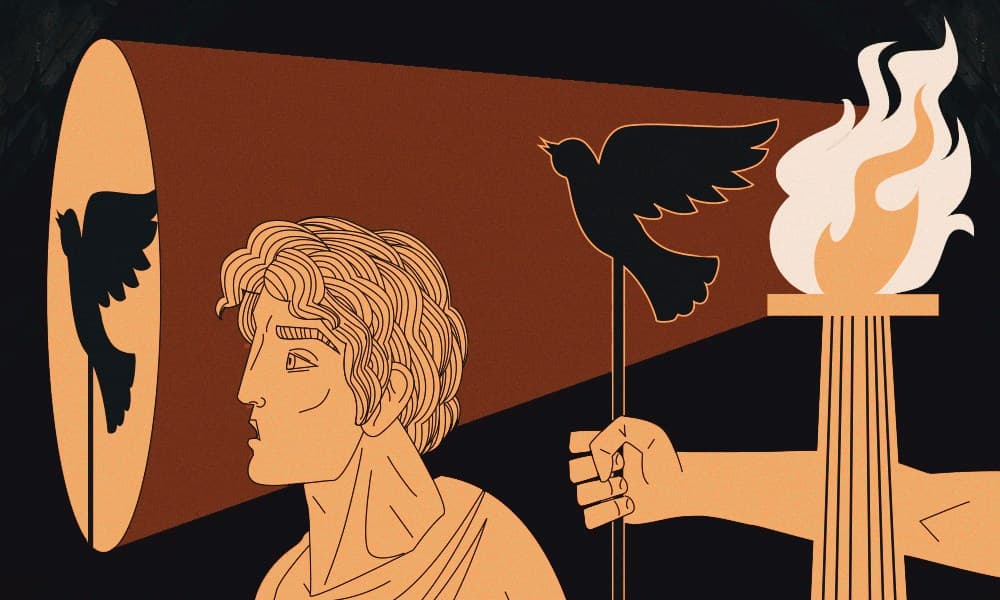
In the allegory, a fire behind the prisoners casts the shadows they watch. In business, that fire is the chain of internal flows running from sale to cash. It starts with sales. Did anyone explain payment terms clearly, collect the right billing contact, or promise special terms that accounting never heard about? It runs through credit, where the question is whether the customer was reviewed before terms were extended and whether the limit was realistic given their history. It runs through invoicing, where accuracy and timing matter as much as the PO number and the backup documents the customer's AP department requires. And it runs through the way disputes are handled. When a customer pushes back, someone has to own the dispute, give it a deadline, and follow up after resolution. When one link in that chain is unclear, collections inherits the mess. The collector sees the final symptom while the cause sits several steps upstream.
The prisoners in the cave are intelligent people working with limited information, and the same is true inside most companies. Sales sees the relationship while accounting sees the ledger, collections sees only the overdue balance, and management watches cash flow from a distance as the customer experiences friction none of them fully observe. Everyone watches their own section of the wall, and the full picture only appears when the company deliberately connects the data. This fragmentation explains why so many collection efforts stall. Each department acts rationally on its partial view while the account ages in the gaps between them. No one is wrong, exactly. They are each describing their shadow accurately, which is precisely what makes the larger truth so easy to miss.
Leaving the cave
In Plato's telling, the prisoner who is freed does not walk happily into the sun. The light hurts. The climb is steep, and for a while the freed prisoner would rather turn back to the familiar wall than keep facing what is real. Businesses feel the same pull. Mapping the entire path from sale to cash is harder than running the aging report, and it often surfaces uncomfortable answers about how your own teams operate. It is easier to keep dialing the same number. But the companies willing to make that climb are the ones that stop mistaking the symptom for the cause.
The practical move is to trace each account back through the chain that produced it, following the balance to the moment the relationship began rather than starting at the overdue date. That means asking where the account originated and who agreed to its terms, whether credit was reviewed before terms were extended, how the invoice was created and what documentation the customer needed attached to it, and what happened the moment a dispute was raised. It means knowing who owns the next step as an account moves from thirty days to sixty to ninety, and when it leaves the building for a third-party agency so the same failure does not quietly repeat on the next order.
Companies that answer those questions stop treating collections as a last-stage recovery function. They start treating it as a feedback loop that reveals where the business flow is breaking. And that shift is where the future of B2B collections is heading. A future-ready process has clear payment terms agreed before the sale closes, clean invoice data, and automated reminders covering the routine accounts. Human collectors focus where they add the most value, on disputes, negotiations, and the complex accounts that need judgment. AI assists with prioritization, summaries, and follow-up timing. Escalation rules are documented so every account moves forward on schedule instead of waiting for someone to notice it.
AI handles shadows faster. Humans still interpret the cave. The strongest collections operations of the next decade will pair both, and they will judge themselves on a wider standard. Collections should recover money and reveal where the business flow is breaking.
That wider standard is really where the allegory has been pointing all along. Once you can see the system, the harder task is convincing everyone else to look. Plato's freed prisoner climbs back down to tell the others what he has seen, and they resist him, because the shadows are all they trust. When you return to the cave, your eyes, now used to the sun, struggle to adjust to the dark, and the ones who stayed behind will call your vision broken, never realizing it was theirs that never healed. The work, then, is not only learning to see the system yourself. It is helping the rest of the business turn away from the wall long enough to see it too.
For more on how technology is already reshaping the industry, read how AI is used in commercial collections. For a stage-by-stage view of what happens after placement, see the commercial debt recovery timeline. When an account has already aged past your internal process, submit it through our placement form and our team will review it the same day.
Frequently asked questions
- What is the future of B2B collections?
- The future of B2B collections is system design rather than harder chasing. Automated reminders handle routine accounts while human collectors focus on complex disputes and negotiations. AI assists with prioritization and follow-up timing. The companies that recover the most will be the ones that map the full path from sale to cash and fix the upstream breaks that create unpaid balances.
- Why do B2B invoices go unpaid?
- A 90-day balance rarely has a single cause. Common drivers include invoice errors, missing purchase orders, unclear payment terms, unresolved disputes, internal approval bottlenecks at the customer, and weak follow-up cadence on the seller side. The visible symptom is the unpaid invoice. The cause is often several steps upstream in the process.
- How can businesses reduce unpaid invoices?
- Start before the sale closes. Set clear payment terms, verify the right billing contact, and confirm documentation requirements up front. Then maintain a consistent follow-up cadence, log every dispute with an owner and a deadline, and define exactly when an account escalates from reminder to demand letter to third-party placement.
- What role will AI play in collections?
- AI handles the routine layer of payment reminders, account segmentation, note summaries, and predicting which accounts need attention first. Human collectors remain essential for disputes, negotiations, and judgment calls. The strongest model pairs both, with AI processing the volume and people interpreting the situations that need context.
Read next
The Commercial Debt Recovery Timeline: What to ExpectA step-by-step breakdown of how commercial debt recovery actually works, from internal collection efforts through agency placement to final resolution.Have an account ready to place?
We work on contingency. No upfront cost.
JSD has been recovering past-due B2B receivables since 1997. Our team reviews every account directly. No intake queue, no automated triage. Most clients are up and running the same day.