Before you start
A single checked box rarely means much on its own. A disputed invoice with no real explanation could be a customer who is genuinely busy. The same dispute showing up after two broken promises and a week of unanswered calls describes an account behaving very differently. Work through the list below, then look at what you have checked as a whole. The pattern carries the signal, not any one line by itself.
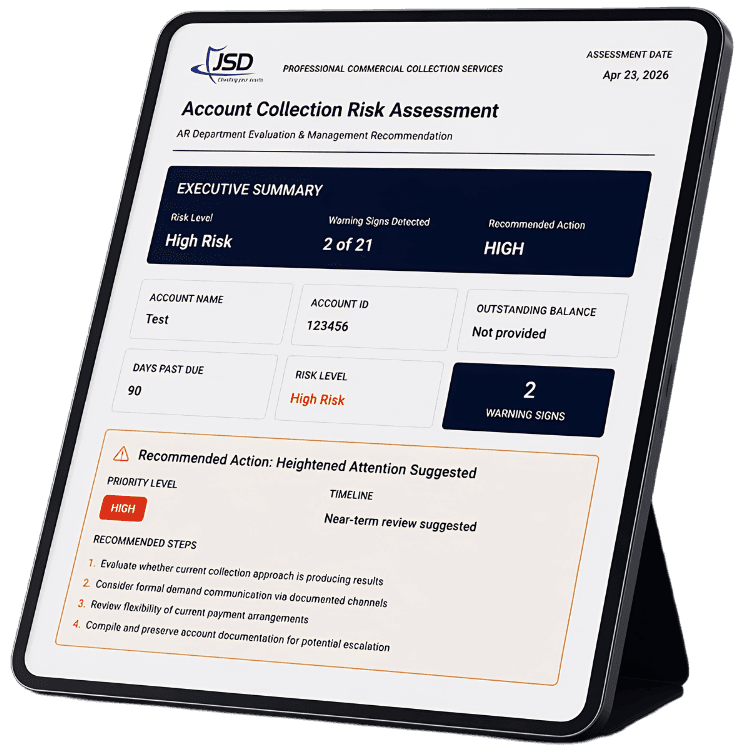
See how this same logic becomes a full accounts receivable early warning system.
01 / Account
Who is the account, what's owed, and what's the payment pattern so far? These four fields anchor the diagnostic.
Early Detection Phase
Credit capacity exists only under ideal conditions
Suggested Considerations
Intent:
You're not rejecting them. You're just getting more information before you take on risk.
Consider: What stops? What escalates? What gets documented?
Risk is intentionally being externalized
Suggested Considerations
Intent:
Risk is being intentionally externalized. Your response should be structural, not emotional.
Consider: What stops? What escalates? What gets documented?
Operating history insufficient to evaluate payment patterns
Suggested Considerations
Intent:
Startups fail quietly and quickly. Time compression is protection.
Consider: What stops? What escalates? What gets documented?
Transparency is being selectively withheld
Suggested Considerations
Intent:
Missing information now becomes disputes later. Delay here prevents delay downstream.
Consider: What stops? What escalates? What gets documented?
Cooperation is conditional rather than standard
Suggested Considerations
Intent:
Reluctance is not neutral. It's a preview of future resistance.
Consider: What stops? What escalates? What gets documented?
Warning Phase
Agreement compliance no longer enforced by client behavior
Suggested Considerations
Intent:
Terms only exist if enforced. Early enforcement prevents later confrontation.
Consider: What stops? What escalates? What gets documented?
Communication being deliberately deferred after acknowledgment
Suggested Considerations
Intent:
Avoidance thrives in informality. Documentation restores balance.
Consider: What stops? What escalates? What gets documented?
Commitments made without consequence when broken
Suggested Considerations
Intent:
The first broken promise is a warning, not an exception.
Consider: What stops? What escalates? What gets documented?
Objections used as delay tactics rather than legitimate concerns
Suggested Considerations
Intent:
Vague disputes delay payment without resolving issues. Precision is the filter.
Consider: What stops? What escalates? What gets documented?
Credit availability contracting across multiple vendors
Suggested Considerations
Intent:
External pressure often precedes internal strain.
Consider: What stops? What escalates? What gets documented?
Payment capacity declining without formal renegotiation
Suggested Considerations
Intent:
Partial payments without structure normalize arrears.
Consider: What stops? What escalates? What gets documented?
Critical Phase
Cash settlement terms actively rejected despite escalation
Suggested Considerations
Intent:
Refusal of standard terms signals a breakdown in financial trust. Secure payment immediately.
Consider: What stops? What escalates? What gets documented?
Dialogue abandoned entirely across multiple attempts
Suggested Considerations
Intent:
Ignoring communication is a direct challenge. Escalating to formal demands asserts control.
Consider: What stops? What escalates? What gets documented?
Pattern of unreliable commitments now established
Suggested Considerations
Intent:
A pattern of broken promises requires a structural shift, not repeated offers.
Consider: What stops? What escalates? What gets documented?
Escalation producing no behavioral change
Suggested Considerations
Intent:
Ignoring formal demands indicates an unwillingness or inability to pay. Proceed with external action.
Consider: What stops? What escalates? What gets documented?
Formal documentation intentionally avoided repeatedly
Suggested Considerations
Intent:
Avoiding documented communication suggests an intent to evade obligations.
Consider: What stops? What escalates? What gets documented?
Severe Phase
Primary contact channels no longer operational
Suggested Considerations
Intent:
Operational disappearance signals intent to abscond. Verify status immediately.
Consider: What stops? What escalates? What gets documented?
Physical presence at known addresses cannot be verified
Suggested Considerations
Intent:
Unverifiable addresses indicate potential evasion or relocation. Confirm current location.
Consider: What stops? What escalates? What gets documented?
Misrepresentation intentional from transaction outset
Suggested Considerations
Intent:
Fraud requires immediate containment and legal intervention.
Consider: What stops? What escalates? What gets documented?
Control transferred to court-appointed administration
Suggested Considerations
Intent:
Court intervention changes the collection landscape; follow legal procedures.
Consider: What stops? What escalates? What gets documented?
Entity relocated without notice or forwarding information
Suggested Considerations
Intent:
An unannounced relocation requires active pursuit to locate assets and address.
Consider: What stops? What escalates? What gets documented?
Review the indicators below to build your assessment.
Developed by JSD Management Inc.
How this assessment works
Enter the customer account information you're evaluating
Check all warning signs that apply to this specific account
Add dates, notes, and your planned actions for each warning sign
Download the professional report to present to management