
Commercial debt collection is the recovery of past-due invoices owed by one business to another, usually handled by a third-party agency that specializes in business-to-business accounts. The practice bears almost no resemblance to the version most people carry in their heads, and the differences are worth understanding before you place your first account.
The short version
- What it is A third-party agency recovering unpaid B2B invoices when your own follow-up has stopped working.
- What it costs Nothing upfront. Reputable agencies work on contingency and take fifteen to fifty percent of what they recover.
- When to use it Sixty to ninety days past due. Recovery odds fall from roughly 85% at sixty days to 27% at one year.
- How it differs Commercial collections sit outside the FDCPA, so business debtors are worked as accountable counterparties rather than protected individuals.

What commercial debt collection is
Almost every B2B transaction rests on a quiet promise. When a supplier ships on net-30 terms, it is extending credit on trust, betting that the buyer will pay weeks after the goods have already left. Commercial debt collection is the mechanism that keeps that promise enforceable when trust alone stops working. An agency steps in after the invoice is past due, makes contact on the creditor's behalf, and works the account toward payment through negotiation, structured plans, or, as a last resort, legal escalation.
A commercial debt is an obligation arising from a transaction entered into for business purposes. The test turns on what the credit was for rather than who signed for it, so a sole proprietor who owes for shop inventory holds a commercial debt even though the debtor is one person. Most creditors arrive at commercial collections after their own receivables process has run out of moves.
How commercial debt collection differs from consumer collections
The law treats the two as different worlds. Consumer debt collection in the United States is governed by the federal Fair Debt Collection Practices Act, which sets strict rules around when a collector can call, how often, and what they are allowed to say, all of it designed to protect individuals from abusive practices. Business debts generally are not covered by the FDCPA. Congress drew that line on purpose. A business dealing with another business on trade credit is a sophisticated party presumed capable of protecting its own interests, and the FDCPA was written for the individual consumer who cannot.
| Factor | Consumer collections | Commercial collections |
|---|---|---|
| Who owes | An individual | A business entity |
| Governing law | Federal FDCPA | State licensing + industry standards |
| Contact rules | Strictly limited hours and frequency | More latitude, still regulated |
| Approach | Protected individual | Accountable counterparty |
| Relationship | Usually one-time | Often an ongoing customer |
Latitude has its own limits. Many states require collection agencies to be licensed or registered, and trade organizations like the Commercial Law League of America and the Commercial Collection Agency Association hold their members to professional standards that reach well beyond what any single state requires. There is a practical difference in how accounts get worked, too. When a manufacturer places a past-due account with a commercial agency, it usually still wants that customer back once the invoice is settled. A professional B2B collector knows this and works the account accordingly. Pressure tactics that might rattle a consumer into paying tend to backfire in a business context, because they burn a relationship that was generating ongoing revenue. That reality is worth keeping in mind for any business that hesitates to place an account, since much of the stigma around using a collection agency comes from consumer-style tactics that professional commercial collectors avoid.
How the commercial debt collection process works
Once an account is placed, the work follows a predictable arc. The creditor hands over the file, which includes the original invoice, the underlying contract, and whatever record exists of earlier collection attempts. The agency starts by reviewing the documentation and account details, checking whether the debt falls within the applicable statute of limitations, and assessing whether the debtor is still an operating business worth pursuing. A professional agency will tell you honestly at the outset when an account is unlikely to justify full effort.
From there the agency often sends a formal written demand stating the amount owed, the basis for the claim, and a window to respond, then moves into direct contact by phone and email. The aim throughout is to reach the person who can actually authorize payment rather than whoever happens to pick up the main line. For a meaningful share of accounts, agency involvement alone is what breaks the logjam. A creditor's own team calling reads as routine follow-up. A third-party collector calling signals that the matter has escalated and the debtor has run out of comfortable ground.
Most commercial accounts resolve through negotiation, whether payment in full, a payment plan, or a settled amount the creditor agrees to accept. Litigation enters only when a debtor refuses to engage entirely, usually as a referral to a collection attorney in the debtor's jurisdiction. It is a genuine last resort, slow and expensive, and it ends any realistic chance of future business. When a debtor has real assets and is simply stonewalling, a judgment can be the only path to recovery. When the debtor is genuinely insolvent, litigation adds cost without adding collected dollars, and a good agency will tell you which situation you are actually in before recommending another dollar spent.
What commercial debt collection costs
Reputable commercial collection agencies work on contingency, which means no upfront fees and no payment until money is actually recovered. The agency gets paid only when you do, which concentrates effort on the accounts worth working. Contingency rates for commercial accounts generally run from fifteen to fifty percent of what gets recovered. The range reflects how much the circumstances vary. A ninety-day account with clean documentation collects more easily and carries a lower rate than an eighteen-month account built on disputed invoices with a debtor who has since moved. Smaller balances carry higher percentages because the fixed cost of the work does not shrink with the dollars at stake.
Any agency that asks to be paid before it has recovered anything has inverted that incentive, and the inversion usually reveals more about how it operates than any sales pitch will. Walk away from any arrangement that wants a retainer or a setup fee before collection begins.
When to place an account with a commercial collection agency
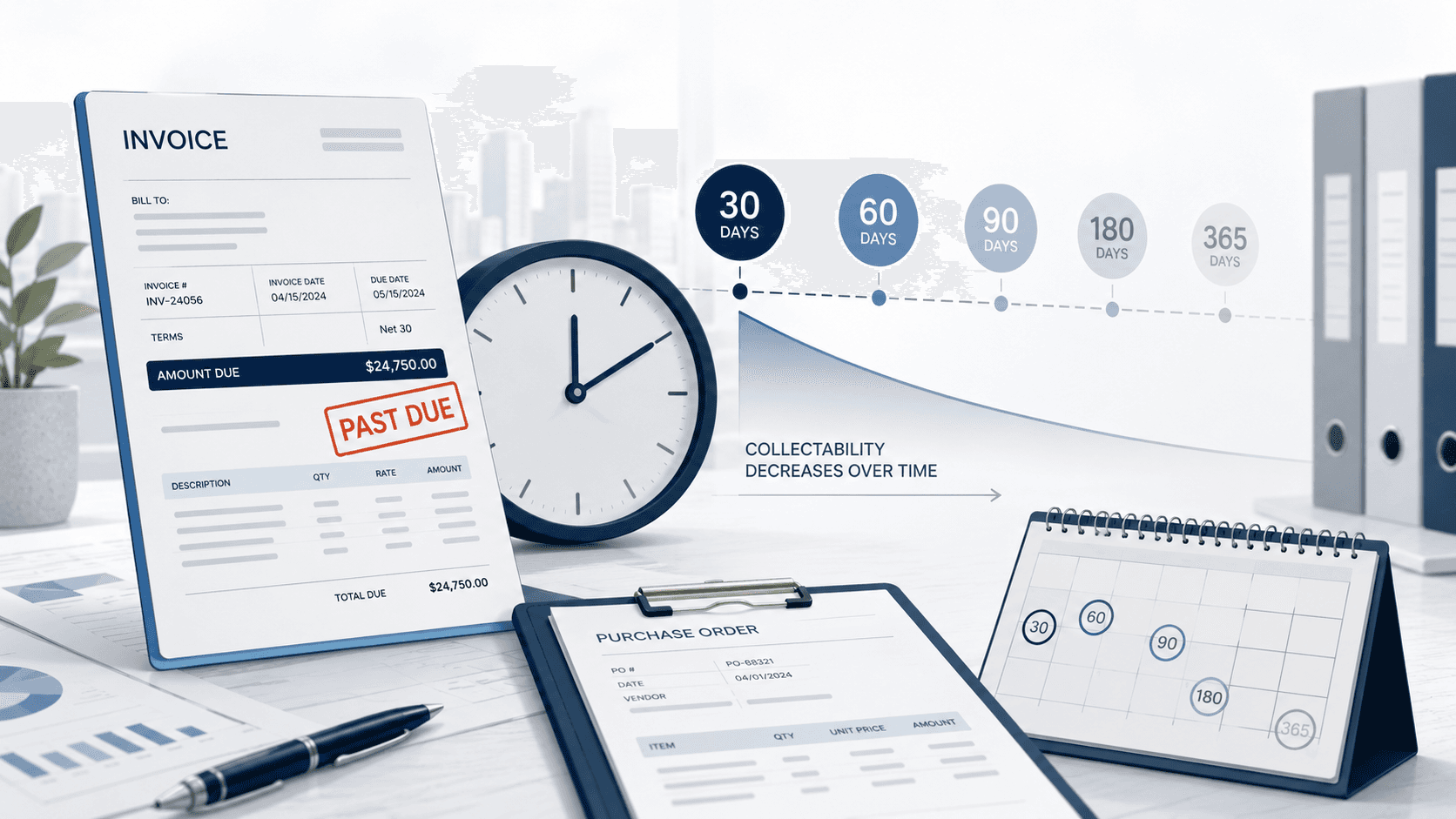
Sixty to ninety days past due, once internal follow-up has clearly run its course. The Commercial Law League of America publishes a collectability chart tracking recovery probability against the age of the account, and the shape of it has held for decades. An account still inside terms carries a 98% probability of collection. That figure holds near 94% at thirty days and 85% at sixty. Ninety days brings it to 74%, and from there the fall accelerates. Six months sits at 58% and nine months at 43%. A year past due carries a 27% probability, and two years carries 14%, which is another way of saying that most two-year-old receivables were written off long before anyone made the decision to write them off. The curve bends hard after ninety days, which is why waiting for a round number like six months or a full year is almost always the wrong instinct. Every extra month of silence teaches the debtor that waiting carries no cost, and in the meantime the contacts and assets you would need to collect against change jobs, close addresses, or become unreachable.
| Age of account | Collectability |
|---|---|
| Due date | 98% |
| 30 days past due | 94% |
| 60 days past due | 85% |
| 90 days past due | 74% |
| 6 months past due | 58% |
| 9 months past due | 43% |
| 1 year past due | 27% |
| 2 years past due | 14% |
The signals worth watching tend to show up well before sixty days. When a debtor who was once responsive goes quiet, when specific payment dates come and go without resolution, when every inquiry gets redirected toward someone who turns out to have no authority to act. The pattern is already telling you something. Placing the account at that point is the right call. Our guide on when to place an account with a collection agency works through the timing decision in more depth.
Choosing a commercial collection agency
Contingency pricing tells you the agency has skin in the game. Licensing tells you whether it can legally collect in your debtor's state, which matters more than most creditors expect. Many states require an agency to hold a license before it can pursue a debtor located there. An unlicensed agency can have its collection activity challenged and its claims dismissed, leaving your account unrecovered while the collectible window keeps closing. Confirm the agency is licensed in your debtor's state before placing anything.
Industry experience carries real weight. A past-due account in manufacturing behaves differently than one in staffing or professional services, and an agency steeped in consumer files or an unrelated commercial vertical may not understand trade credit norms, purchase order disputes, or the relationship stakes particular to your field. Ask what share of their book resembles your accounts before assuming they understand them.
Ask how they handle accounts you still hope to keep as customers. Every call the agency places goes out in your name. An agency running the same aggressive template across every file is telling you how it sees the work, and if that posture damages the relationship you were trying to save, the agency has cost you more than the invoice was worth.
Why commercial debt collection matters
Most B2B commerce in the United States runs on payment terms, with a supplier shipping on net-30 or net-60 and trusting the buyer to pay once the goods are long delivered. The entire arrangement rests on the assumption that an unpaid invoice has something standing behind it. Strip that assumption away and suppliers would demand cash in advance for everything, trade credit would dry up for the businesses that depend on it, and the supply chains most industries take for granted would slow. Commercial collection agencies are background infrastructure for that system. The creditor who recovers a forty-thousand-dollar invoice through a professional agency gets the money back and stays in a position to extend the same trust to the next customer, which is where the promise behind the invoice began.
Businesses ready to move from internal follow-up to outside recovery can use JSD's commercial debt collection services to handle unpaid B2B invoices while keeping outreach, documentation, and negotiation with one team. Our walkthrough of the commercial debt recovery process follows a placement from start to resolution. When you are ready to hand off a file, the placement form gets it to us directly.
Frequently asked questions
- What is commercial debt collection?
- Commercial debt collection is the recovery of past-due invoices owed by one business to another, typically handled by a third-party agency specializing in B2B accounts. The debtor is a business entity rather than an individual. The legal framework, communication approach, and recovery methods are all distinct from consumer collections.
- What is the difference between consumer and commercial debt collection?
- The core difference is legal. Consumer debt collection is governed by the federal Fair Debt Collection Practices Act, which strictly limits when and how collectors can contact debtors. Commercial debt collection falls outside the FDCPA because both parties are presumed to be sophisticated businesses. Commercial collectors are instead governed by state licensing requirements and trade association standards. The practical difference shows in how accounts are worked, with business debtors approached as accountable counterparties rather than protected individuals.
- How much does commercial debt collection cost?
- Reputable commercial collection agencies work on contingency, meaning no upfront fees and no payment unless funds are recovered. Contingency rates typically range from fifteen to fifty percent of the recovered amount, depending on the age of the debt, balance size, and whether legal action becomes necessary. Any agency charging a retainer or setup fee before recovery should be avoided.
- When should I use a commercial collection agency?
- The general rule is sixty to ninety days past due, once internal follow-up has stopped producing results. Recovery probability drops sharply after ninety days, so earlier placement consistently produces better outcomes. Key signals include a debtor going silent after previous communication, broken payment promises, and repeated inability to reach anyone with payment authority.
- Does commercial debt collection affect the business relationship?
- It depends on the agency. Professional commercial collectors are trained to preserve the creditor's relationship with the debtor where the creditor wants the debtor back as a paying customer. The goal is professional communication that recovers the money without making the relationship harder to repair afterward. A well-run commercial collection can reset a business relationship on cleaner terms rather than ending it.
- What is the commercial debt collection process?
- Once an account is placed, the agency reviews the documentation and account details to assess the debtor's status. It often begins with a formal written demand and moves into direct contact by phone and email, aiming to reach whoever holds payment authority. Most accounts resolve through negotiation, whether payment in full, a payment plan, or a settled amount. Litigation enters only when a debtor refuses engagement entirely and has assets worth pursuing.
- What industries use commercial debt collection?
- Any industry that extends trade credit to business customers uses commercial collections. Common industries include manufacturing, wholesale distribution, staffing, freight and logistics, construction, media, printing, and professional services. The defining characteristic is that the debt arises from a commercial transaction between business entities.
Read next
When to Place an Account with a Collection AgencyThe 60-90 day rule, the warning signs that an account is ready, and what actually happens once you place it with an agency.Have an account ready to place?
We work on contingency. No upfront cost.
JSD has been handling commercial collections since 1997. Every placement is reviewed by our team. Most clients are up and running the same day.