
How to Turn the Vital Warning Signs Checklist Into an AR Early Warning System
Most companies already hold everything needed to identify which customers are sliding toward non-payment. The accounting system has the balance and the terms. The payment history shows days to pay drifting from 32 to 51 across five invoices. A CRM note from February records a promised check that never arrived. The clerk who has worked the account for six years knows the controller stopped returning calls in March. Four facts, four places, and nobody has put them side by side. The Vital Warning Signs checklist names those observations by their proper terms. Breaks promise to pay without immediate follow-up. Avoids contact after acknowledging balance. Twenty-one signs in total, across four tiers. Once a sign has a name it can be defined, tracked, and wired into an accounts receivable early warning system that flags at-risk accounts whether or not anyone remembers to look.
The short version
- An AR employee reviews an account and marks which of the 21 signs are present, with dates. Judgment becomes something a manager can review and a collector can inherit.
- Each sign gets a written action. Break terms means one thing. Breaks second promise to pay means another. The response stops depending on who is working the file, or how they feel about the customer that day.
- Signs with a date field become queries. Signs written in prose become AI classification. Both flag at-risk accounts before the aging report would. Several signs never automate, since they arrive by phone or in a conversation, and the placement decision stays with a person.
- To score a live account against the full list and produce a report you can hand to management, use the assessment tool.
The information is already in the building
Payment risk rarely arrives as new information. By the time a balance becomes a problem, the evidence has usually been recorded three or four times in three or four systems. The invoice date sits in the accounting software. The partial payment that arrived without any revised agreement sits in the ledger as a credit. The promise sits in a collection note as free text that no report queries. The unanswered thread sits in one person's inbox, invisible to everyone else.
What is missing is a common vocabulary. Two AR clerks looking at the same account will describe it differently, and neither description makes it into a field anything can sort on. One says the customer is being difficult. The other says they are just slow. Both may be looking at the same behavior, and neither observation can be counted, compared, or escalated, because a description is not a signal until everyone agrees what to call it.
The checklist supplies the names, and the naming is most of the work. "Being difficult" becomes disputes with little or no detail, which is a specific claim about a specific behavior that another person can verify by reading the dispute. "Just slow" becomes break terms, which has a date attached to it. The vague version starts an argument. The named version starts a procedure.
What the four tiers are actually tracking
Read the tiers in order and the structure becomes clear. The checklist tracks how quickly the creditor's options are closing. A marginal credit application is a decision you get to make. A skip is a decision that has been made for you. Any single sign rarely settles anything on its own, which is why the tier a sign sits in carries as much information as the sign itself.
| Tier | When | Signs |
|---|---|---|
Early Detection Phase | Before credit is extended |
These are credit decisions rather than collection problems. Every one of them is visible before you ship. |
Warning Phase | The relationship is changing |
The tier where intervention still costs almost nothing, and the tier most often missed. |
Escalation Phase | Internal effort has stopped producing results |
The customer is now avoiding resolution rather than delaying it. This is a decision on their side rather than an oversight. |
Recovery at Risk | Locating the business becomes the work | Recovery now depends on documentation, filing deadlines, and finding the business rather than on persuasion. These conditions narrow the options without closing them. |
The same family of behavior hardens as it moves down the list. Reluctant to provide information in the first tier and refuses certified letters in the third both avoid creating a written record, the same instinct at different stages of the relationship. Breaks promise to pay appears in Early warning, and breaks second promise to pay appears in Red flags, because a second broken promise means the pattern has repeated rather than a single incident. The tiers measure how fast the door is closing, and the same progression is mapped to customer behavior in the three stages of a customer in trouble.
Why the aging report misses at-risk accounts
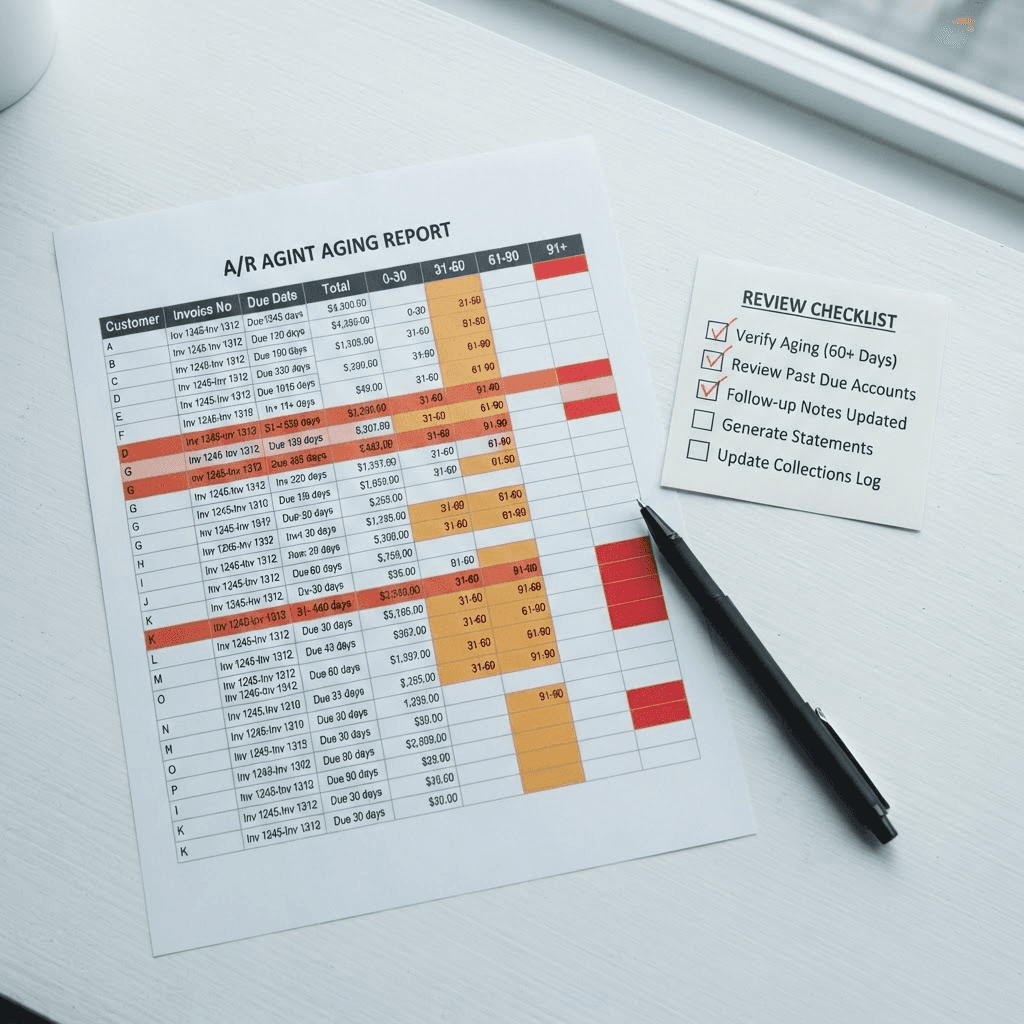
Most AR teams already run a report that sorts balances by age, and it is easy to assume that report is the early warning system. It measures one variable, which is how long the money has been outstanding. Two accounts sitting in the same 60-day column can be in completely different condition, and the report has no way to show the difference.
One of them belongs to a customer who called last week, explained a delayed receivable of their own, and gave a date. The other belongs to a customer who acknowledged the balance in March and has not answered a call since. There is no column for refusing certified letters, no column for a promised check date that passed with nobody following up, and no column for a dispute that surfaced for the first time after four contact attempts.
The behavioral layer is what separates them, and it is the reason an account can be identified as at risk weeks before its balance reaches the column where anyone escalates. Age tells you how long you have been waiting. Behavior tells you what you are waiting for.
Level one, a checklist you can point at
An experienced AR employee already senses when an account is going bad. The trouble with instinct is that it cannot be handed to anyone. It does not survive a vacation, a resignation, or a supervisor asking why this account is being escalated and that one is not. Instinct also loses arguments. A clerk who says the customer feels wrong has no answer when a sales manager pushes back on the credit hold.
Working the checklist converts the same instinct into marked boxes with dates. Break terms, February 14. Avoids contact after acknowledging balance, March 2. Partial remittance without revised agreement, March 19. Disputes with little or no detail, April 8, after four contact attempts. The clerk who produces that record is no longer offering an impression. They are showing four named signs with a timeline, and the sales manager pushing back now has to argue with dates.
The record also travels. A collector inheriting the file knows what the creditor observed, when they observed it, and what they did about it. Most disputes that reach an agency get settled by documentation rather than by memory, and the creditor holding contemporaneous notes wins those arguments before they start. The assessment tool produces that record as a report you can hand to a manager or attach to a placement.
Level two, a rule for each sign
Marking a sign and responding to one are different acts, and most AR operations stop after the first. The account gets noted and the response depends on who is working the file, how full their week is, and how much they want to avoid an uncomfortable phone call. Every promise that passes without documented follow-up teaches the customer that the next promise will also be free.
The second level writes the response down in advance. The checklist already assigns each sign a recommended action and a response time, which makes it usable as a specification. Treat the recommended action as the floor a single sign triggers, and let the tier decide how far it escalates. Your version can be stricter, but it has to be written.
| Sign | Required action | Response time |
|---|---|---|
| Break terms | Suspend discretionary extensions. Enforce stated terms moving forward | Immediate |
| Breaks promise to pay without immediate follow-up | Require written payment confirmation for future arrangements. Limit further flexibility | Immediate |
| Disputes with little or no detail | Request written dispute with supporting documentation. Pause further concessions until received | Within 7 days |
| Partial remittance without revised agreement | Apply payment to oldest balance. Require formal agreement for any partial payment plans | Immediate |
| Breaks second promise to pay | Terminate informal payment arrangements. Require written agreement with fixed dates or escalate account handling | Immediate |
Notice the qualifier in the second rule. A missed payment date on its own is weak evidence, since a customer can miss one for reasons that have nothing to do with intent. The sign is without immediate follow-up, which points at the silence after the date rather than the date itself. A customer who calls the morning the check did not arrive and offers a revised date is behaving differently from one who simply goes quiet. That distinction is precise enough to build a rule against.
Written rules also move the confrontation off the individual. A clerk enforcing a policy is in a stronger position than one making a judgment call, both with the customer and internally with sales, because the company wrote the rule before the account existed. The discomfort of enforcing it becomes a cost the company absorbs as policy rather than a decision one clerk has to defend alone.
Which warning signs can be automated
Once every sign has a definition and a trigger, a portion of the detection stops needing a person. A clerk working 200 accounts will always catch ignores final demand. The account where break terms and partial remittance without revised agreement both fired in February is the one that slips, because early signs are undramatic by nature and 200 accounts is too many to hold in memory.
The signs fall into three detection groups. Some reduce to date arithmetic the accounting system already holds. Others live in prose and reply patterns, which is where AI earns its place. It earns that place partly because it does not feel the pull to extend grace to an account it recognizes, the way a person managing a ten-year relationship does. A model reading six months of collection notes can distinguish a customer who committed to a date from one who said they would look into it, and it can tell a slow reply from a customer who has stopped engaging entirely.
| Detection method | Signs |
|---|---|
Runs as a query Dates and amounts already in the accounting system |
|
Needs AI classification The signal lives in prose, reply patterns, and timing |
|
Stays manual permanently The event never touches your systems |
|
The manual group matters more than its size suggests. Client's competitors start calling for credit references is one of the more revealing signs on the list precisely because it comes from outside your data, arriving as a phone call from another vendor. A system that only watches your database will never see it. Used this way, AI functions as a monitoring layer over records that already exist, watching for the patterns the checklist names, assembling the supporting evidence, and putting the account in front of a person with the relevant history attached. That is the same boundary AI in collection work generally respects. The work stays in research and detection. The conversation with the customer stays with a person.
Why the rule holds anyway
The hardest part of this system is never spotting the sign. It is the moment right after, when the account belongs to a customer who has paid on time for ten years and the sign that just fired is avoids contact after acknowledging balance. The controller stopped answering calls three days ago. The rule calls for a shift to documented communication within the week. The account manager who has worked this relationship for a decade has a different response ready, which is to wait, since this does not feel like the kind of account the rule was written for.
History is exactly what makes waiting feel reasonable, and waiting is the expensive part. Many accounts that end up written off passed through a stretch where another week of patience still felt reasonable to someone with a believable reason for it.
Enforcing the response anyway carries a real cost. A ten-year customer shifted into documented, formal-sounding communication over what still reads as a small lapse may take it personally, and some of that reaction is fair. A strained relationship is usually recoverable once the account is current again, a phone call and an explanation close most of the distance. The other cost is less forgiving. Recovery probability on a past-due commercial account falls from 94% at thirty days to 27% at one year, as set out in the collectability figures published by the Commercial Law League of America. Once that slide starts, waiting does not buy back the odds it spent.
| Response | What it feels like | What it actually costs |
|---|---|---|
| Enforce the recommended action | Cold, maybe unfair to a customer with a clean history | A strained relationship, usually repaired once the account is current again |
| Extend grace because of the relationship | Reasonable, loyal, deserved | A balance that keeps aging past the point where recovery odds are still good |
Build the trade-off into the record rather than leaving it as a private call. Once an account carries a Red flags or Critical stage sign, choosing an action that differs from the recommended one should require a written justification that lands in the report alongside the sign. The rule stays breakable. It becomes expensive to break quietly, which turns out to be the more useful property.
An account flagged in week three and ignored until month five has produced a better-documented version of the same loss, which is where the rise in business bankruptcies tends to end up. The value of the earlier warning is entirely in acting earlier.
Which returns to the four facts sitting in four systems. The balance, the drifting payment pattern, the promise nobody logged as broken, and the thread that stopped getting answers. Put on one screen with dates against them, they stop being separate irritations and become a picture of a customer who has already decided where this vendor ranks. Naming them early is the whole point of the checklist. When the names start coming from the Red flags tier instead of Early warning, placing the account is the next rule in the sequence.
Frequently asked questions
- What is an accounts receivable early warning system?
- It is a defined set of behavioral signs, each with a written meaning and a required action, applied consistently across every account. Rather than relying on an experienced clerk noticing that a customer feels wrong, the company names the signs in advance. Break terms. Avoids contact after acknowledging balance. Breaks promise to pay without immediate follow-up. Disputes with little or no detail. Once each sign has a name and a trigger, the same account gets the same response regardless of who reviews it, and much of the detection can run on data the company already stores.
- How do you build an early warning system for accounts receivable?
- Start with a named vocabulary rather than a dashboard. Adopt a defined list of behavioral signs, such as the 21 in the Vital Warning Signs checklist, and have AR staff mark which are present on each account with dates. Then write down the required response for every sign, so the action is decided before the account exists. Only after those two levels are working does automation help, because a query can only look for a sign that already has a definition and a trigger behind it. Building it in the other order produces a dashboard nobody acts on.
- How do you identify at-risk accounts receivable before they go bad?
- By tracking behavior alongside balance age. An account is at risk when the customer starts breaking terms, goes quiet after acknowledging what they owe, misses a promised payment date without calling, or raises a dispute with nothing specific in it. Those behaviors appear well before the balance reaches the column on the aging report where anyone escalates it, and each of them can be defined precisely enough to be tracked rather than sensed.
- What data do you need to build one?
- Almost always data the company already has. Invoice dates and amounts from the accounting system, payment history showing days to pay per invoice, email activity showing whether replies are still coming, CRM or collection notes recording promises and disputes, and credit application details from onboarding. The obstacle is rarely missing data. The aging report lives in one system, the broken promise lives in a note, and the unanswered thread lives in someone's inbox, so nobody sees the three of them together.
- Which warning signs can be automated and which cannot?
- Signs that reduce to numbers or dates automate well. Break terms, partial remittance without revised agreement, and breaks promise to pay all have a date field behind them. Signs written in prose need AI classification to detect, such as disputes with little or no detail, which requires reading the dispute to judge whether it contains specifics. Some signs cannot be automated at all because the data does not live in your systems. Client's competitors start calling for credit references arrives by phone, and owner of company refuses to sign personal guarantee happens in a conversation during onboarding. Those stay manual permanently.
- Can AI decide when to send an account to collections?
- No, and it should not be built that way. AI is good at the detection layer. It can read free-text collection notes and classify whether a customer made a commitment or deflected, spot that days to pay has drifted materially across several invoices, and flag when a thread that used to get same-day replies has gone unanswered for three weeks. What AI should never do is decide an account gets a pass because the relationship is old or the balance is small. The system flags the account and the recommended action fires. A person carries that action out, and can choose something different, but should have to record why.
- How is this different from the aging report we already run?
- An aging report measures one variable, which is how long the balance has existed. It has no column for whether the customer refused certified letters, whether a promised check date passed without anyone following up, or whether a dispute surfaced for the first time after four collection attempts. Two accounts in the same 60-day column can be in completely different condition. The early warning system adds the behavioral dimension the aging report cannot see.
- Where does the Vital Warning Signs checklist fit in?
- The checklist is the vocabulary layer. It defines 21 signs across four tiers, from pre-credit Indicators through Early warning, Red flags, and Critical stage, and assigns each one a recommended action and response time. You can use it manually on a single account, or use it as the specification that your written rules and automated flags are built against.
Read next
When to Place an Account with a Collection AgencyThe 60-90 day rule, the warning signs that an account is ready, and what actually happens once you place it with an agency.Have an account ready to place?
We work on contingency. No upfront cost.
JSD has been handling commercial collections since 1997. Every placement is reviewed by our team. Most clients are up and running the same day.