
The Bond Market Just Repriced Your Customers' Credit Lines
Your Aging Report Has Not Noticed Yet
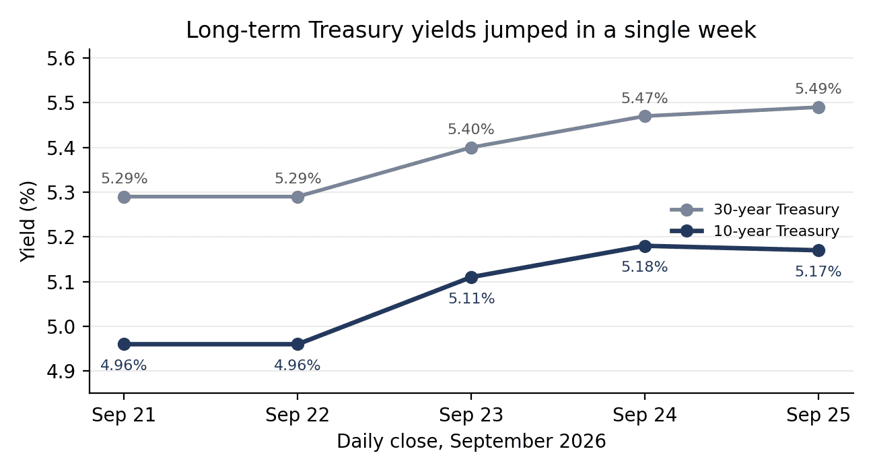
Long-Term Yields Jumped in a Single Week
The 10-year Treasury yield closed at 4.96% on Monday, September 21. By Thursday it had touched 5.22% intraday, its highest level since 2007, and the 30-year bond briefly cleared 5.5% for the first time since 2004. That is a move of more than 20 basis points in one week, in what is supposed to be the most boring market in the world. The triggers all pointed in the same direction: hotter-than-expected S&P Global business activity data, energy-driven inflation, soft demand at a $70 billion five-year note auction, and a Federal Reserve that raised rates on September 16 for the first time since 2023 and has made it clear it is not finished.
The Selloff Hits Where You'd Expect
The stock market's reaction has been oddly split, and the split is the interesting part. Through September 25, the S&P 500 was up slightly for the month and about 1% below its record, according to Raymond James, even as the 10-year climbed 43 basis points. Underneath that calm headline, rate-sensitive sectors took the hit. Utilities fell 6.3%, financials 5.2%, and real estate 4.6%, while the small-cap Russell 2000 sat roughly 8% below its high. The reason is mechanical. When a risk-free Treasury pays north of 5%, every other asset must justify its price against that number, and the companies that feel it first are the ones borrowing at floating rates. Raymond James puts the share of small-cap debt tied to short-term floating rates at 54%. The Dow gave back more than 300 points on September 28 as the 10-year pushed back above 5.2%. Mega-cap earnings are big enough to absorb this for now. Mid-sized companies running on bank credit are a different story, whether that is a regional distributor or a family-owned manufacturer leaning on a line of credit.
Where the Money Actually Comes From
That second group is who a lot of B2B suppliers invoice every day, and here is the part that never makes the market wrap. When the prime rate moved to 7% on September 17, every revolving credit line priced off prime got more expensive on its next statement. A controller at a mid-sized customer staring at a pricier revolver has a few options, and the easiest one needs no bank approval and no new paperwork: pay vendors later. Stretching days payable outstanding is effectively an interest-free loan from suppliers, and when bank money gets more expensive, trade credit quietly becomes the cheapest financing on the balance sheet. Nobody announces it. The invoice that used to clear in 35 days clears in 48, then 55.
The Trap in Your Aging Report
On the supplier's side, that looks like almost nothing at first. DSO creeps up a few days, which is easy to blame on seasonality or a short-staffed AP department on the other end. The 30/60/90 buckets still look tidy. That is the trap, because an aging report can make disorder look organized, and a customer financing itself with your receivable will stay "current-ish" right up until the day it stops paying. The accounts worth watching are not the ones that suddenly stop paying. They are the ones whose payment rhythm changed this month and whose explanation sounds new.
If Yields Keep Climbing
Which raises an important question: what happens if the bond market keeps heating up? Mohamed El-Erian, Allianz's chief economic adviser, told CNBC he does not expect the 10-year yield to drift back toward 4.5% even if oil cools, and he warned that the big danger is interest-rate risk turning into credit and equity risk. That sequence deserves attention. Credit markets are still calm, with high-yield corporate bonds yielding about 7.8% on September 24, a modest 2.8-point spread over Treasuries. But the bond market's own fear gauge, the MOVE Index, just posted its biggest one-day jump since 1990, and the latest seven-year note auction cleared 57 basis points above August's. Markets are already pricing in Fed hikes at both remaining 2026 meetings. If yields keep grinding higher, the pain shows up first in refinancing. Leveraged, private-equity-backed, and floating-rate borrowers who planned around cheaper money hit maturity dates at rates their cash flow cannot carry. Even the AI infrastructure boom is feeling it; CNBC reported that some data center financings are getting harder to close, with SoftBank paying as much as 9.75% on one junk-bond tranche. For the broader economy, that means slower capital spending, softer hiring, and, for anyone extending trade credit, more customers whose "slow pay" is really the early stage of insolvency.
Delay, Not Inability
The uncomfortable pattern, after watching receivables cycle through several rate environments, is that most commercial debt gets lost to delay rather than genuine inability to pay. A customer squeezed by a higher revolving rate will pay the vendors who ask firmly and on schedule, and stretch the ones who do not. Every deadline you let slide reinforces which category you are in. Recovery at that point is not about aggression. It is about documentation, timing, and knowing whether you are looking at an AP backlog, a real dispute, or a cash squeeze, because each one calls for a completely different conversation.
A practical place to start: run your last two quarters through JSD Management's free AR Turnover and DSO calculator and compare the periods side by side. If DSO has drifted more than a few days since summer, pull the specific accounts driving it and check whether their payment timing changed around mid-September. Those are the calls to make now, while credit markets are still calm and your customers still have options, and well before the 60-to-90-day mark, when the conversation gets a lot harder.
Sources
- Dow falls for a third day as bond yields hit fresh highs: Live updates (CNBC, Sept. 23, 2026) — https://www.cnbc.com/2026/09/23/stock-market-today-live-updates.html
- Dow tumbles more than 300 points, Nasdaq drops 1% as Treasury yields surge: Live updates (CNBC, Sept. 22, 2026) — https://www.cnbc.com/2026/09/22/stock-market-today-live-updates.html
- Dow slides more than 300 points to start week as Treasury yields pressure stocks (CNBC, Sept. 28, 2026) — https://www.cnbc.com/2026/09/27/stock-market-today-live-updates.html
- Global bond sell-off deepens, sending borrowing costs higher around the world (CNN, Sept. 24, 2026) — https://www.cnn.com/2026/09/24/investing/bond-market-global
- How rising bond yields are shaping the market outlook (Raymond James, Sept. 25, 2026) — https://www.raymondjames.com/moorhousefinancial/resources/2026/09/25/weekly-investment-strategy
- Market Yield on U.S. Treasury Securities at 10-Year Constant Maturity (FRED DGS10) — https://fred.stlouisfed.org/series/DGS10
- Market Yield on U.S. Treasury Securities at 30-Year Constant Maturity (FRED DGS30) — https://fred.stlouisfed.org/series/dgs30
- Current Prime Rate: 7.00% as of September 2026 (PrimeRates) — https://primerates.com/primerate/current-prime-rate/
- Corporate & High Yield Bond Yields and Spreads (StreetStats, Sept. 24, 2026) — https://streetstats.finance/rates/corporates
- El-Erian Warns 10-Year Yield Could Stay Around 5% Even If Oil Falls (Stocktwits) — https://stocktwits.com/news-articles/markets/equity/el-erian-warns-10-year-yield-could-stay-around-5-even-if-oil-falls-flags-too-much-of-an-imbalance-in-supply-and-demand-of-bonds/cZMSDHdRBQr
- Tremors are rippling across the U.S. Treasury market (Tipswatch, Sept. 27, 2026) — https://tipswatch.com/2026/09/27/tremors-are-rippling-across-the-u-s-treasury-market/
- Debt-hungry AI companies face increased risk as bond yields spike (CNBC, Sept. 27, 2026) — https://www.cnbc.com/2026/09/27/debt-hungry-data-center-companies-increased-risk-bond-yields-spike.html
- What To Expect From Interest Rates For The Rest Of 2026 (Forbes, Sept. 29, 2026) — https://forbes.com/sites/simonmoore/2026/09/29/what-to-expect-from-interest-rates-for-the-rest-of-2026
- Every Fed Rate Hike Since 1971: What 55 Years of Tightening Say About the 2026 Hike (MAS Economics, Sept. 29, 2026) — https://maseconomics.com/fed-rate-hike-history-1971-2026/
Read next
Business Bankruptcies Are Accelerating in 2026Business bankruptcy filings are accelerating, especially among smaller companies. The first warning often appears in payment behavior long before it reaches a court docket.Have an account ready to place?
We work on contingency. No upfront cost.
JSD has been handling commercial collections since 1997. Every placement is reviewed by our team. Most clients are up and running the same day.