
America Is Building Factories Again
Why Suppliers Feel the Slowdown Before the Plants Open
Factory Announcements Keep Piling Up
In the span of about ten days this September, Array Technologies opened a $50 million solar tracker plant in Albuquerque, New Mexico. USA Rare Earth broke ground on a $1.2 billion magnet factory in Blacksburg, South Carolina. Hitachi Energy said it would spend $528 million on a transformer plant in Gallman, Mississippi, the company's largest single U.S. investment to date. One tracker now counts $2.07 trillion in announced U.S. manufacturing commitments since the start of 2025, spread across 237 companies and 42 states. So is manufacturing opening more factories in the United States? Yes. But the more useful answer is about timing, and that is where it starts to matter for anyone who sells to these plants on terms.
What the Census Numbers Show
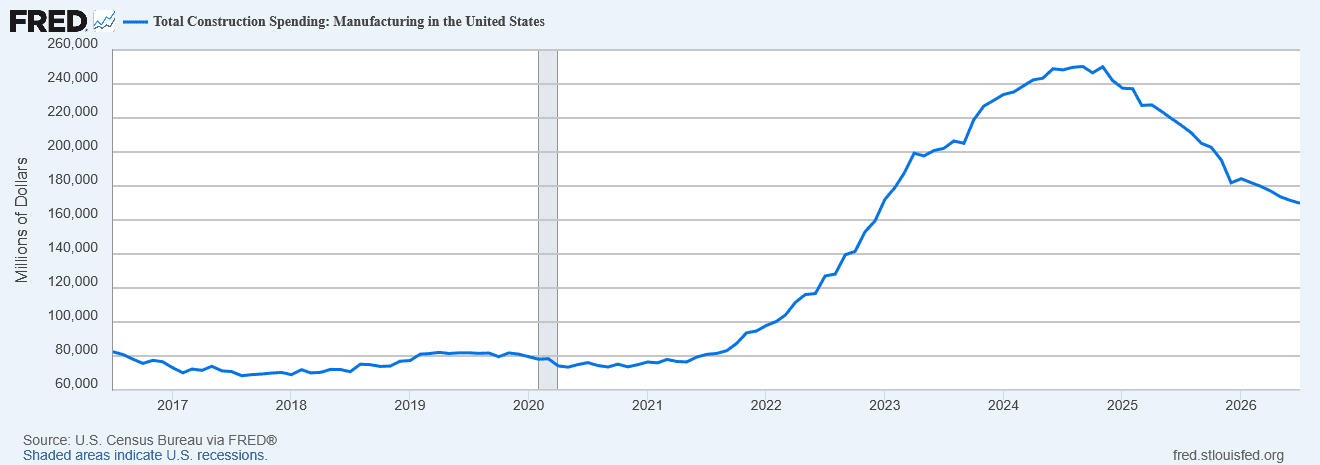
The Census Bureau's July construction report looks, at first glance, like it is describing a different country. Spending on manufacturing construction fell 1.0% in July to a $169.8 billion annual rate. Through the first seven months of 2026, it ran 22% below the same period last year, and it now sits 32% below its September 2024 peak of $250.2 billion. Both numbers hold up once you look inside the total. About 95% of the drop came from computer and electronics plants as the wave of semiconductor fabs started under the CHIPS Act finishes up. Strip that out and the rest of factory construction is roughly flat, and even after the pullback, the country is still building factories at more than twice its 2019 pace.
The Lag Between Announcement and Groundbreaking
The real story is the gap between the press release and the concrete. Piedmont Crescent Capital's chief economist puts the lag from announcement to groundbreaking at roughly nine months for electrical equipment plants and seventeen for steel mills. Chip plants take far longer, at twenty-eight to thirty-nine months. Micron announced its Clay, New York site in October 2022 and broke ground this January. USA Rare Earth will not begin commissioning until 2028, and Hitachi's Mississippi lines are not slated to produce until 2029. In the meantime, the money has moved inside buildings that already exist. Orders for core capital goods hit $85.9 billion in July, the highest reading since that series began in 1992, and metalworking machinery orders through July were up 37% from a year earlier. Established names are expanding too. U.S. Steel just brought its largest blast furnace at Gary Works in Indiana back online after a $350 million reline, and Curia finished a $200 million expansion of its drug-filling campus in Albuquerque.
The Two Risks for Suppliers
That lag creates two risks for suppliers, and the first is how the money moves. A factory boom does not pay its vendors on the day of the ribbon cutting. It pays them on milestones, and increasingly with public money somewhere in the chain. Curia's expansion drew federal funding from HHS and the Department of Defense, along with support from the state of New Mexico. SteelFab's $19 million Fayetteville expansion carries a state performance grant, and Rivian had to amend its Department of Energy loan in April for its Georgia plant. When a milestone slips or a funding term gets renegotiated, the general contractor waits longer for its next draw and slows what it pays the fabricator. The machine shop three levels down never hears about any of it. It just watches a 45-day invoice turn into a 75-day one, and the payment drifts.
The second risk is quieter: new customers. When ArtiCast opens its $10.3 million die-casting plant in Jackson, Tennessee, specifically to sit closer to Southeastern customers, its local suppliers will be extending credit to a facility with no payment history at that address. The same goes for a U.S. subsidiary of a foreign parent, or a venture-backed defense startup like Covenant, whose new Dallas factory will not start production of its flagship system until early 2027. Strong demand tends to loosen credit standards, and asking for a deposit from the company bringing hundreds of jobs to the county can feel like a fast way to lose the account. Demand is not guaranteed, either. Manufacturing output slipped 0.3% in August after seven straight monthly gains, which may be a one-month blip. The steadier signal is capacity utilization, which sits at 76.3%, more than three points below its long-run average.
Reading Your Own Aging Report
In the commercial accounts JSD works, stalled payments more often trace back to a dispute or an upstream cash problem than to a customer refusing to pay. They are often a project-finance problem wearing a receivables costume. The customer is waiting on its own draw, a change order is unsigned, the delivered spec does not match the PO, and everyone is perfectly polite about it. That is precisely the environment where an aging report misleads. A stack of invoices in the 60-day bucket looks like normal project timing until you notice that three of them belong to the same customer whose funding just got restructured. And every extension granted during that stretch teaches the customer your terms bend whenever theirs do.
So yes, America is building factories, but slowly, unevenly, and on a clock measured in years rather than quarters. If you are selling into that buildout, a good place to start is checking whether your Days Sales Outstanding is creeping up while your customer list gets more impressive. JSD Management's free AR Turnover & DSO Calculator compares two periods side by side, which makes that kind of drift hard to miss. If an account tied to a new plant has slid past 60 days without a clear, documented reason, that is the one to deal with first, while the relationship is still cordial and your working capital is still yours.
Sources
- Nearly $2B in facility investments by US Steel, USA Rare Earth and more (Manufacturing Dive, Sept. 11, 2026) — https://www.manufacturingdive.com/news/us-steel-usa-rare-earth-array-covenant-september-investments-openings/830151/
- Manufacturing output down in August; investments by Reckitt, Hitachi (Manufacturing Dive, Sept. 18, 2026) — https://www.manufacturingdive.com/news/reckitt-hitachi-energy-aricast-hovione-economic-warn-act-layoffs/830764/
- July Construction Spending: Building Fewer Factories, Buying More Equipment (Piedmont Crescent Capital, Sept. 1, 2026) — https://piedmontcrescentcapital.com/construction-spending-july-2026-building-fewer-factories-buying-more-equipment/
- Monthly Construction Spending, July 2026 (U.S. Census Bureau) — https://www.census.gov/construction/c30/pdf/release.pdf
- US Manufacturing Investment Tracker 2026 (IndustrialSage, updated Sept. 10, 2026) — https://www.industrialsage.com/us-manufacturing-investment-tracker/
- The 2026 U.S. Manufacturing Construction Boom (Westside Construction Group) — https://www.buildwcg.com/blog-posts/us-manufacturing-megaprojects-construction-2026
- Total Construction Spending: Manufacturing in the United States (U.S. Census Bureau via FRED, Federal Reserve Bank of St. Louis) — https://fred.stlouisfed.org/series/tlmfgcons
Read next
Fed Rate Hike and Accounts Receivable RiskA higher prime rate makes receivables gaps more expensive to bridge while cost pressure gives customers another reason to pay later.Have an account ready to place?
We work on contingency. No upfront cost.
JSD has been handling commercial collections since 1997. Every placement is reviewed by our team. Most clients are up and running the same day.