
Short answer
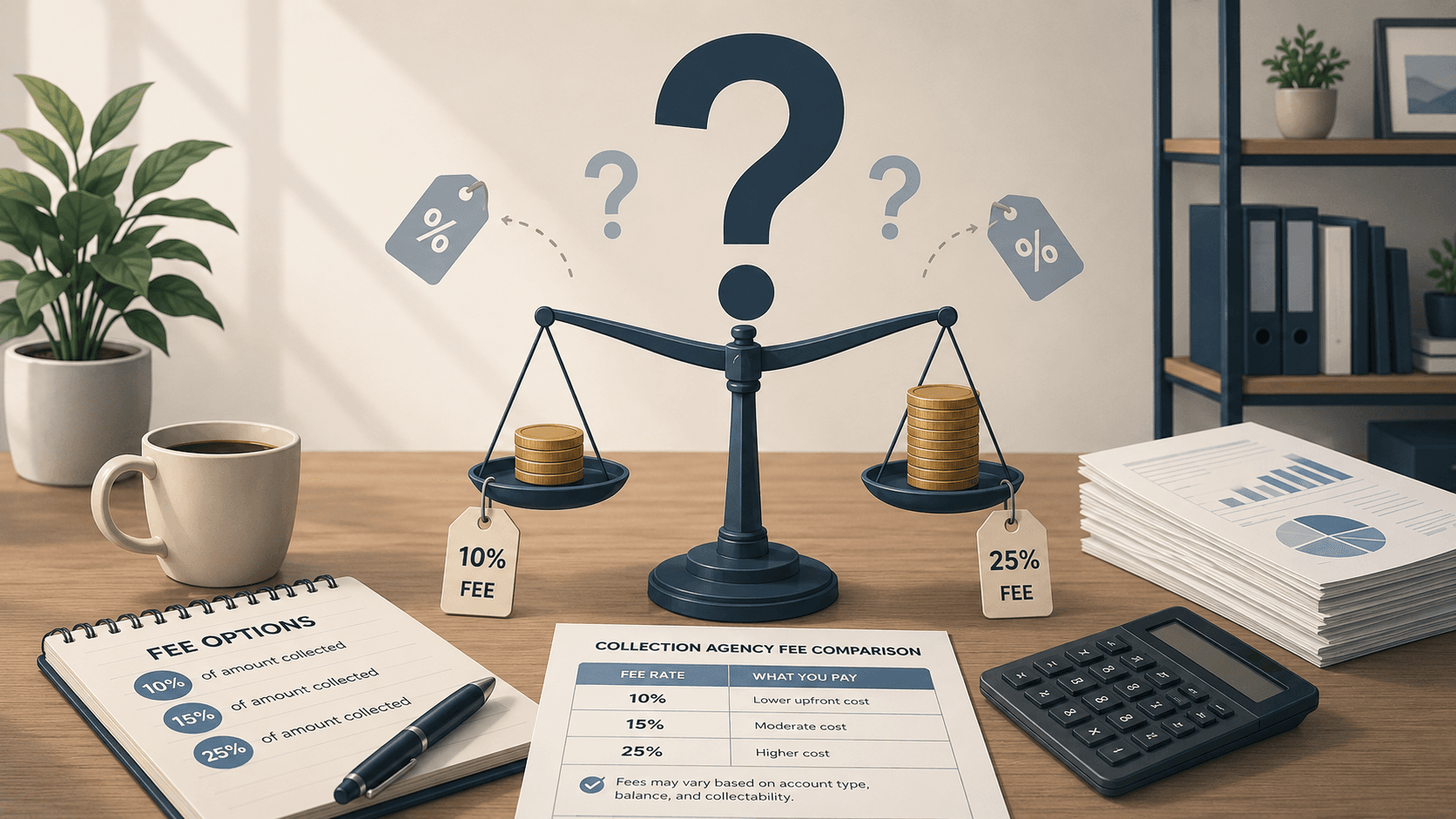
Commercial collection agency fees commonly run from 15% to 45% of the money recovered. Under a standard contingency agreement, there is generally no upfront agency fee, and the agency earns no contingency fee if it collects nothing.
Older accounts, smaller balances, disputes, and likely legal work tend to move the rate higher. Court costs and attorney expenses may be separate. The percentage matters, but the useful comparison is how much cash reaches your business after the fee.
Asking what a collection agency charges is reasonable. The mistake is expecting one percentage to describe every account, every service, and every likely result.
A recent six-figure invoice supported by a signed contract is not the same assignment as a two-year-old $900 balance with a dispute attached. Both can be quoted on contingency, but the work available to perform and the risk of earning nothing are different. That is why a useful fee discussion starts with the pricing structure, then moves to the account that produced the quote.
Typical commercial collection agency fee structures
Most commercial agencies use a contingency fee. The agency receives an agreed share of recovered funds and earns that fee only when money is collected. Other arrangements exist, but they buy different work and place the risk in different places.
| Fee structure | How it works | What to confirm |
|---|---|---|
| Contingency | The agency keeps an agreed percentage of money recovered. | The rate, when it changes, and what sits outside it. |
| Flat-fee or letter service | The creditor pays for a defined notice or limited campaign. | Whether calls, disputes, follow-up, or reporting are included. |
| Legal escalation | Suit may use a higher contingency, separate costs, or both. | Who authorizes costs and how attorney fees are handled. |
A fee schedule is only a starting point. The placement agreement controls the actual arrangement, and a client should know whether direct payments, payment plans, returned funds, legal escalation, and account withdrawal change the fee before placing an account. JSD explains how its contingency is settled on the payments and remittances page.
What changes a collection agency rate
Commercial contingency rates commonly fall between 15% and 45%, but no responsible quote comes from the balance alone. An agency is pricing the amount available to recover, the work the account is likely to require, and the chance that the work produces no fee at all.
What usually moves the quoted percentage
- Account age. Recent debt generally carries a lower rate than old debt because contacts, records, leverage, and the debtor's ability to pay tend to deteriorate with time.
- Balance size. A small balance can require many of the same calls, documents, and compliance steps as a large one, so the cost of the work consumes more of the possible recovery.
- Dispute history and documentation. A clean invoice supported by a signed agreement is different from an account that requires the agency to reconstruct the transaction before it can answer the debtor.
- Placement volume. A portfolio of similar, well-organized accounts may be priced differently from one isolated account because intake and handling become more predictable.
- Expected legal work. A file likely to require local counsel, suit, or judgment enforcement carries work and expense beyond ordinary agency collection.
Age is the factor a creditor can still influence before placement. Waiting for one more internal promise can feel free, but the account is becoming harder while the business waits. Our guide to when to place an account with a collection agency explains where internal follow-up usually stops paying for itself.
Who pays the collection agency fee
In the ordinary contingency arrangement, the creditor pays the agency from recovered funds. If the agency collects $10,000 at a 25% rate, the agency fee is $2,500 and the creditor's net recovery is $7,500, subject to the placement agreement and any separately authorized expenses.
Some commercial contracts state that the debtor must reimburse collection costs or attorney fees after default. That language may allow the creditor to seek those costs, but the right depends on the contract and applicable law. It should not be assumed, and a fee should not be added after default simply because the account was placed for collection. Contract language should be reviewed before costs are demanded from the debtor.
Direct payment does not necessarily avoid the contingency. If a debtor pays the creditor after agency placement, many agreements still treat that payment as a recovery subject to the agreed fee. The placement agreement should say how direct payments and offsets are reported and handled.
Litigation, court, and other costs outside the contingency
A contingency fee does not always include every expense that could arise. Filing fees, service of process, certified records, local counsel, post-judgment enforcement, and similar costs may be separate. Skip tracing or other specialized work may also be treated separately by some agencies.
Legal escalation should not arrive as a surprise on a remittance statement. Before suit, the creditor should receive a recommendation, an estimate of known costs, an explanation of the applicable attorney or agency fee, and a clear request for authority to proceed. The client should also know whether it advances the costs or whether approved costs can be deducted from a recovery.
The useful question
Ask what can be charged without further approval, what requires written authorization, and how costs are treated if the suit produces no recovery.
Compare net recovery, not the rate alone
A percentage is easy to compare because it is known before the work begins. Recovery performance is harder to compare because it appears later. That encourages buyers to optimize the visible number even though the amount retained after fees is the financial result.
Consider two agencies working the same delinquent account.
| Agency A | Agency B | |
|---|---|---|
| Contingency rate | 15% | 25% |
| Amount recovered | $10,000 | $20,000 |
| Agency fee | $1,500 | $5,000 |
| Client keeps | $8,500 | $15,000 |
Agency A quoted the lower rate. Agency B left the creditor with $6,500 more. This example does not mean a higher rate produces a higher recovery. It means rate alone cannot tell a buyer which proposal is less expensive in the end.
Net recovery depends on how much is collected, how quickly it is collected, and what fees and approved costs come out of it. It also depends on whether the agency understands the contract, receives a complete placement file, reaches the right person, and uses legal escalation selectively. The page on how to compare commercial collection agencies covers those operational questions in more detail.
What to ask before placing an account
Ask for the collection agency rate plainly, then ask enough questions to learn what the percentage includes. A quote is useful only when the creditor can tell which accounts it covers, when it changes, and which decisions can create additional cost.
Questions worth putting in writing
- What contingency rate applies to this account, and what facts would change it?
- Is any fee due before recovery or if the agency collects nothing?
- How are direct payments, payment plans, settlements, and returned funds handled?
- Which court, attorney, research, or service costs sit outside the contingency?
- Who must authorize legal action, and what estimate will be provided before it begins?
- When and how are recovered funds remitted to the client?
The fee should be understandable before the account moves. The result will never be perfectly predictable, but the agreement can still make the economics clear. Start with the rate, identify the exceptions, and compare the likely net recovery with what continued internal follow-up is producing now. JSD's commercial collection services include direct account handling, documentation, negotiation, and escalation under a contingency model, so the quoted rate can be compared with the work behind it.
Frequently asked questions
- How much do collection agencies charge?
- Commercial collection agency fees commonly range from 15% to 45% of the amount recovered. The quoted percentage depends on the age and size of the balance, dispute history, placement volume, expected legal work, and other facts that affect the effort and risk involved.
- What is a typical commercial collection agency contingency fee?
- A typical commercial contingency fee falls somewhere within a 15% to 45% range, with recent, larger, well-documented accounts generally priced lower than old, small, disputed, or legally complex accounts. Actual rates vary by agency and placement agreement.
- How much does it cost to hire a collection agency?
- Under a standard contingency agreement, there is generally no upfront agency fee. The agency earns an agreed percentage only from money it recovers. Flat-fee letter services and legal action use different pricing, and court or attorney costs may require separate client approval.
- Who pays collection agency fees?
- The creditor usually pays the agency fee from recovered funds. A contract may permit the creditor to seek collection costs from the debtor, but enforceability depends on the contract language and applicable law. A business should not add a collection fee after default without a valid contractual and legal basis.
- Is there a collection agency fee if nothing is recovered?
- Usually not under a standard contingency arrangement. If the agency recovers nothing, it earns no contingency fee. Separate expenses, such as an authorized court filing or service fee, may still be payable if the client approved legal action.
- Are litigation and attorney costs included in the contingency fee?
- Not always. Filing fees, service of process, local counsel, and other litigation expenses may sit outside the agency contingency or may change the applicable rate. The placement agreement should state which costs are separate, who approves them, and whether they are advanced or deducted from a recovery.
- Is a lower collection agency rate always cheaper?
- No. The rate determines the agency's share, but the recovery determines the dollars available to divide. A higher-rate agency can leave the creditor with more cash if it also recovers substantially more of the balance. Compare net recovery after fees rather than rate alone.
Read next
When to Place an Account with a Collection AgencyThe 60-90 day rule, the warning signs that an account is ready, and what actually happens once you place it with an agency.Have an account ready to place?
We work on contingency. No upfront cost.
JSD has been handling commercial collections since 1997. Every placement is reviewed by our team. Most clients are up and running the same day.