
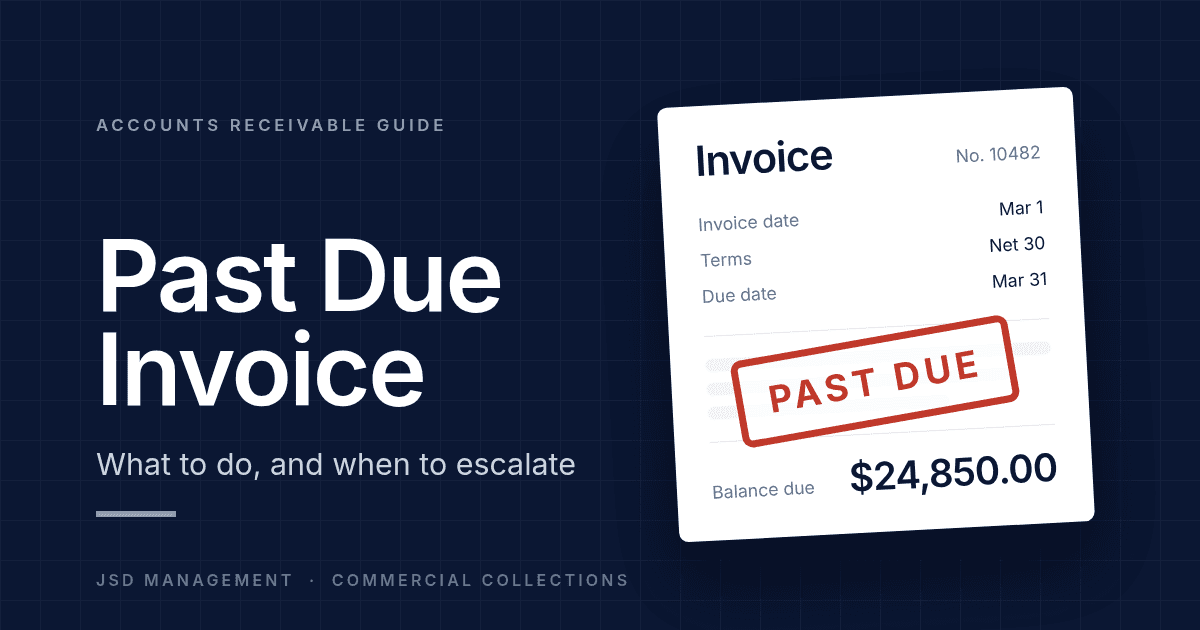
A past-due invoice is one that is still unpaid after the due date set by your payment terms, so a net-30 invoice dated March 1 becomes past due the day after March 31. With a business customer, you first confirm the invoice arrived and nobody disputes it. Then you get a specific payment date in writing, and when that date passes without money, you escalate.
Plenty of invoices still drift for months after a sensible start like that, because the reason the money has not arrived matters as much as the amount, and each reason calls for a different response.
An Invoice Is Past Due the Day After Terms Run Out
The due date comes from your terms, not from the day the customer opened the email. Net 30, net 45, and due on receipt all start the clock on the invoice date unless your contract says otherwise, and once that date passes the invoice is past due. An “overdue invoice” means the same thing, and the two terms get used interchangeably.
Past due and outstanding mean different things. Every unpaid invoice is outstanding, but only the ones beyond terms are past due, and only those belong in your collection workflow. They also land in the first bucket of your AR aging, which is where most receivables trouble begins. A few days late on a large commercial invoice is usually paperwork, while thirty days late is a pattern worth a phone call.
How to Collect a Past-Due Invoice, Step by Step
Begin on your own side. Check that the invoice number, amount, and terms match the purchase order or contract, and that the invoice went to the address or portal the customer's accounts payable team actually uses. A meaningful share of commercial delinquency is nothing more than an upload a vendor portal rejected, or a missing PO number that left the invoice parked in an approval queue nobody is watching.
Contact the customer within a few days of the due date and ask whether the invoice arrived and whether anything about it is in dispute. If the answer to the second question is yes, settle the dispute first, in writing. No amount of reminding will move a payment the customer believes it does not owe.
If the invoice arrived and nobody disputes it, ask for a specific payment date rather than a general assurance. “Next week” is not a date. A named date gives you something to hold the customer to and a clear trigger for the next step. Once the invoice crosses 15 to 30 days, move from email to the phone, since email reminders are easy to ignore and a conversation is where you learn whether the delay is a process issue or something more serious.
When the promised date passes, send a formal final notice that states the balance, sets a firm deadline of roughly ten days, and says plainly what happens next. Our free 10-day demand letter template can save you drafting time here. Late fees and interest belong in this letter only if they were in your terms before the invoice went out, and the limits on what you can charge vary by state.
Then do what the letter said. If the deadline passes without payment or a credible plan, the account is ready for placement with a collection agency or referral to an attorney. The common rule of thumb is to place an account somewhere around 60 to 90 days past due, and sooner when warning signs stack up. Our post on when to place an account covers that timing in more detail.
Why Past-Due Invoices Keep Piling Up
Late payment is getting more common. In the 2026 edition of its small business late payments report, QuickBooks found that 59 percent of surveyed businesses had invoices overdue by 30 days or more, up from 47 percent the year before. Businesses waiting on unpaid invoices were owed an average of about $17,700.
Two findings in the report matter to anyone extending credit. Terms shape delinquency, since 55 percent of businesses on net-30 terms had overdue invoices against 26 percent of those requiring immediate payment. Every extra week a customer is allowed to hold your money gives the invoice that much longer to lose its place in line.
The second finding is that late payment travels. Forty-two percent of businesses said outside pressures had delayed payments they owed to their own suppliers, and among businesses with invoices more than 30 days overdue, nearly a quarter named delayed revenue as the specific reason. Your customer may be late because its customer is late, which makes your past-due invoice a symptom of someone else's receivables problem.
What a Late Payment Is Telling You
Most past-due invoices on a commercial account trace back to paperwork, to a disagreement nobody has voiced, or to a customer deciding which vendors get paid this month. They look identical on an aging report, because a 45-day balance is a 45-day balance whether the invoice is stuck in an approval chain or sitting below someone else's on a priority list.
The difference shows up in how the customer behaves when you ask. Paperwork problems produce quick, specific answers, such as an invoice that needs a PO number or went to the wrong inbox. Disputes surface when you ask about them directly, often with a note of relief that someone finally did. Cash problems sound different, with vague promises, partial payments that arrive without explanation, a contact who was responsive last quarter and now is not, and a request to “resend the invoice” for the third time. Our warning signs assessment can help you score which pattern an account is showing.
After nearly three decades in commercial collections, the pattern we see at JSD Management is that the costly past-due invoices are rarely the ones a customer flatly refused to pay. They are the ones where a deadline came and went without consequence, and the customer learned that this particular balance could wait. Every unenforced date teaches that lesson a little more firmly, which makes the timing of escalation matter more than its tone.
When a Past-Due Invoice Needs Outside Help
Once a past-due invoice has passed your final deadline, the account has changed. The customer has heard from everyone on your side who could reasonably contact it, and it has decided, consciously or not, that your invoice ranks below someone else's. Another internal reminder rarely moves that ranking. A third party with a documented process often does, because it signals that the balance is now a receivable to be recovered and no longer a relationship to be managed.
If you are at that point, read how commercial debt collection works for business-to-business balances, including what a placement involves and how contingency-based recovery means there is no fee unless money is recovered. Gather the contract or terms and the invoice, add any purchase order, and attach the log of your follow-up. That file turns a stalled balance into a recoverable one, and when you are ready you can place the account with us directly.
A date only means something once someone acts on it, and the file you hand over is the record that somebody did.
Sources
QuickBooks (Intuit), 2026 Small Business Late Payments Report, “More small businesses are carrying overdue invoices than last year.”
Frequently asked questions
- When is an invoice considered past due?
- An invoice is past due the day after the due date set by your payment terms. A net-30 invoice dated March 1 becomes past due on April 1, and the clock starts on the invoice date unless your contract says otherwise.
- What is the difference between a past-due and an outstanding invoice?
- Every unpaid invoice is outstanding, but only the ones beyond terms are past due. Past-due invoices are the ones that belong in your collection workflow and in the first bucket of your AR aging.
- When should you send a past-due invoice to collections?
- The common rule of thumb is to place an account with a collection agency somewhere around 60 to 90 days past due, and sooner when warning signs stack up or after your final deadline passes without payment or a credible plan.
- Can you charge late fees on a past-due invoice?
- Late fees and interest generally need to be in your terms before the invoice goes out, and the limits on what you can charge vary by state. Check your contract and your state's rules before adding a charge to a final notice.
Read next
When to Place an Account with a Collection AgencyThe 60-90 day rule, the warning signs that an account is ready, and what actually happens once you place it with an agency.Have an account ready to place?
We work on contingency. No upfront cost.
JSD has been handling commercial collections since 1997. Every placement is reviewed by our team. Most clients are up and running the same day.