
Oil Is Near $102 and Diesel Set a Record
West Texas Intermediate crude settled near $102 a barrel on Wednesday after trading as high as $103.50 earlier in the session, and Brent was changing hands above $115. Last December, WTI bottomed out around $55. A near doubling in roughly ten months would be a headline on its own, but finance teams have felt it more directly through diesel, which set an all-time weekly record of $6.53 a gallon in late September after opening the year below $3.50.
What the EIA Expects Through 2027
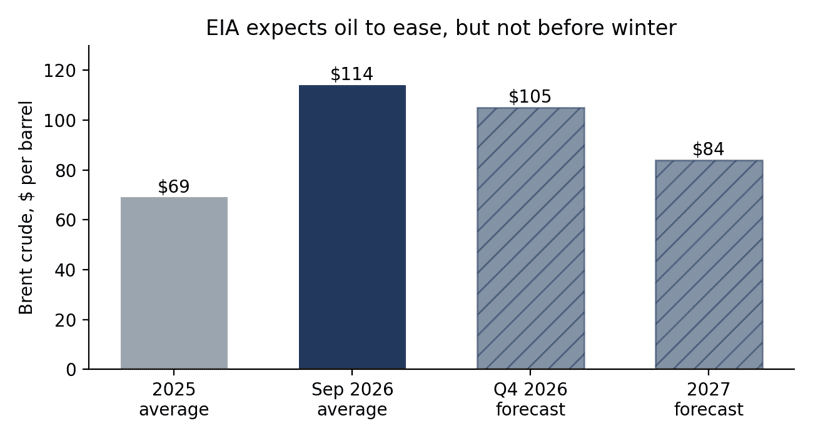
So the question on every budget call this quarter is whether those costs come down over the next six months. The government’s own forecasters say yes, eventually, and not soon enough to help this winter. In its October Short-Term Energy Outlook, the Energy Information Administration expects Brent to average $105 a barrel in the fourth quarter, a full $14 above what it projected only a month earlier, before easing to an $84 average across 2027 as Middle East production shut-ins shrink from 4.5 million barrels a day this quarter to 2.7 million in the first quarter of next year. Diesel, the fuel that actually moves inventory, is the stickier problem. EIA sees retail diesel holding above $6 through October and declining only gradually toward roughly $4.50 next year, with East Coast distillate stocks running 20 to 30 percent below normal all winter. The revisions tell a story of their own. In a single month, EIA raised its 2027 Brent call from $74 to $84. Recent forecasts have moved in one direction, and a budget built on spring relief is a budget built on hope.
Costs Are Already Rising
The costs are not waiting for the forecast to resolve. The Producer Price Index for final demand rose 1.3 percent in September, its largest monthly gain since March 2022, and is up 6.3 percent over twelve months. Producer prices for diesel are up 115 percent year over year, and diesel alone accounts for nearly half of September’s increase in processed goods for intermediate demand. Those numbers describe a very specific gap: the distance between what your customers quoted their own customers last spring and what it costs them to deliver this fall.
How an Energy Shock Becomes a Receivables Problem
The mechanism that turns that gap into a receivables problem is a speed mismatch. Many carriers now reset fuel surcharges weekly instead of monthly, so a distributor’s freight costs reprice every Monday. That same distributor’s contracts with a hospital system or a general contractor were priced months ago and will not reprice until renewal. The difference has to be financed somewhere, and for a business already squeezed on margin, the cheapest financing available is the supplier’s invoice. Nobody calls a vendor to announce a plan to pay late. They simply stop paying at thirty days, because stretching days payable outstanding requires no conversation, no credit application, and no signature. That is why an energy shock reaches the aging report long before it reaches the bankruptcy docket, though in trucking the docket is already filling, with at least 16 carriers filing for bankruptcy in roughly a month as diesel climbed.
What It Looks Like on Your Aging Report
On your side of the ledger, this rarely looks like a crisis. The 31-to-60-day bucket gets heavier without anything dramatic happening. A customer who paid in 32 days now pays in 47, with a perfectly reasonable explanation about fuel costs. Because each account is only a couple of weeks behind and the excuse is true, nobody escalates. The aging report stays tidy, and that tidiness is the problem. DSO drifts up a few days a month, and six months of drift adds up to a materially different business.
Payment Habits Do Not Reset When Prices Fall
The part that concerns us more than the price of a barrel is what happens after it falls. Payment habits formed over six months do not reset when diesel returns to $4.50. A customer who spent the winter learning that net-30 means net-55, and that nothing happens when it does, carries that lesson into 2027. Every deadline a creditor declines to enforce teaches the debtor that the balance is negotiable, and an oil shock hands every accounts payable department a sympathetic reason to test that.
What Collections Is Actually For in an Energy Squeeze
This is also where commercial collections gets misunderstood. What is a collection agency actually for in a market like this one? Not the last stop for an account that is already gone. Recovery depends on timing and documentation far more than pressure, and the most useful thing a good collector does in an energy squeeze is sort accounts early. A customer bridging a temporary fuel-margin gap, a customer disputing a surcharge buried in a purchase order, and a customer quietly sliding toward insolvency can all show the same 45-day payment on an aging report. They need very different responses, and the window to tell them apart is the 60-to-90-day range, not the moment someone decides to wait and see what spring brings.
How to Test Your Exposure Before Q4 Close
Before your fourth-quarter close, run your third-quarter receivables against the second quarter in JSD Management’s AR Turnover and DSO Calculator, using its two-period comparison. If DSO has climbed by more than a few days since summer, the oil market has already reached your balance sheet, whatever the futures curve says about next year. Then pull the names behind that movement. The customers whose habits changed this fall are the ones worth a direct conversation now, while the conversation is still about timing and not about whether the money exists.
Sources
- Crude Oil - Price - Chart - Historical Data - News (Trading Economics) — https://tradingeconomics.com/commodity/crude-oil
- Crude Oil Price Today: October 28, 2026 (Forbes Advisor) — https://www.forbes.com/advisor/investing/oil-prices-today/
- Crude Oil Prices (1946-2026) (Macrotrends) — https://www.macrotrends.net/1369/crude-oil-price-history-chart
- EIA expects a mixed picture for winter fuel costs this year (EIA press release, October 6, 2026) — https://www.eia.gov/pressroom/releases/press593.php
- EIA Lifts Its 2026 Brent Forecast to 96 Dollars and Sees 105 in the Fourth Quarter — https://edgeconsultancykw.com/eia-short-term-energy-outlook-october-2026-brent-forecast/
- What Is a Fuel Surcharge in Trucking? How It’s Calculated and Who Pays (Excargo) — https://www.excargo.com/fuel-surcharge-trucking/
- Producer Price Indexes - September 2026 (BLS news release) — https://www.bls.gov/news.release/ppi.nr0.htm
- Producer Price Index up 6.3 percent in September; largest 12-month increase since December 2022 (BLS, The Economics Daily) — https://www.bls.gov/opub/ted/2026/producer-price-index-up-6-3-percent-in-september-largest-12-month-increase-since-december-2022.htm
- Soaring diesel prices force carriers to update fuel surcharges weekly instead of monthly (DC Velocity) — https://www.dcvelocity.com/technology/transportation-it/transportation-load-planning-tms/soaring-diesel-prices-force-carriers-to-update-fuel-surcharges-weekly-instead-of-monthly
- Trucking News Roundup: Owner-Ops Hit by $6.39 Diesel, Carrier Bankruptcies (Maas Logistics, October 3, 2026) — https://maaslogistic.com/news/2026-10-03-diesel-oo-squeeze-bankruptcies-tender-rejections-ohio-tax-holiday
Read next
Record Diesel Prices Raise Trucking Receivables RiskDiesel hit a record $6.53 a gallon and at least 16 trucking companies filed for bankruptcy. For anyone who sells to carriers, the warning shows up on the aging report first.Have an account ready to place?
We work on contingency. No upfront cost.
JSD has been handling commercial collections since 1997. Every placement is reviewed by our team. Most clients are up and running the same day.